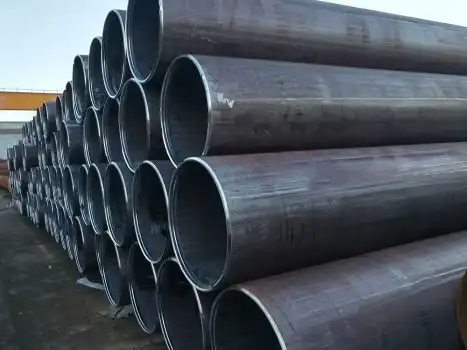
What Is API 5L?
API Spec 5L (American Petroleum Institute Specification 5L) defines the requirements for manufacturing seamless and welded steel line pipes used in pipeline transportation systems for petroleum, natural gas, and water.
The API 5L specification is the primary procurement reference for EPC contractors and pipeline operators worldwide. It is published by the American Petroleum Institute and covers the full production chain from raw material through testing and marking.
Standard Scope and ISO 3183 Equivalence
API 5L covers two Product Specification Levels — PSL1 and PSL2 — each with distinct chemical, mechanical, and testing requirements. PSL1 is the standard quality tier. PSL2 adds stricter chemical limits, mandatory impact testing, full traceability, and access to sour service (Annex H) and offshore (Annex J) annexes.
API 5L and ISO 3183 were jointly developed and co-published through the 44th edition (2007). From the 45th edition onward, the two standards are separately maintained but remain technically aligned in grade structure and scope. The ISO 3183 grade designation uses an "L" prefix followed by the minimum yield strength in MPa:
| API 5L Grade | ISO 3183 Grade | Min Yield Strength |
|---|---|---|
| Grade B | L245 | 241 MPa (PSL1) / 245 MPa (PSL2) |
| X42 | L290 | 290 MPa |
| X52 | L360 | 359 MPa (PSL1) / 360 MPa (PSL2) |
| X60 | L415 | 414 MPa (PSL1) / 415 MPa (PSL2) |
| X65 | L450 | 448 MPa (PSL1) / 450 MPa (PSL2) |
| X70 | L485 | 483 MPa (PSL1) / 485 MPa (PSL2) |
The "X" prefix in grade names represents minimum yield strength in ksi (1,000 psi). For example, X52 indicates a minimum yield strength of 52,000 psi. Grade B predates this naming convention and does not carry the prefix.
API 5L 46th Edition — Key Updates
The API 5L latest edition — the 46th edition — was published in 2018 and became effective May 2019. It was developed through consensus in API's Subcommittee on Tubular Goods and includes technical updates to PSL2 sour service annexes and offshore requirements.
The official standard is copyrighted and sold through api.org. The specification data on this page is compiled from publicly available technical references and our own supply documentation.
API 5L Grades Overview
API 5L pipe grades range from Grade B (general service) through X70 (high-pressure trunk and offshore pipelines). Each grade is defined by minimum mechanical properties and chemical composition limits. The tables below cover API 5L pipe specs for PSL1 and PSL2 separately — these two levels specify different minimum values and must not be mixed.
PSL1 Mechanical Properties (per API 5L Table 3A)
All values below are minimums per standard. PSL1 does not specify maximum yield or tensile strength.
| Grade | ISO 3183 | Min Yield (MPa) | Min Yield (psi) | Min Tensile (MPa) | Min Tensile (psi) |
|---|---|---|---|---|---|
| B | L245 | 241 | 35,000 | 414 | 60,000 |
| X42 | L290 | 290 | 42,000 | 414 | 60,000 |
| X52 | L360 | 359 | 52,000 | 455 | 66,000 |
| X60 | L415 | 414 | 60,000 | 517 | 75,000 |
| X65 | L450 | 448 | 65,000 | 531 | 77,000 |
| X70 | L485 | 483 | 70,000 | 565 | 82,000 |
PSL2 Mechanical Properties (per API 5L Table 3B)
PSL2 specifies both minimum and maximum values, plus a yield-to-tensile ratio limit (Rt0.5/Rm ≤ 0.93).
| Grade | ISO 3183 | Min Yield (MPa) | Max Yield (MPa) | Min Tensile (MPa) | Max Tensile (MPa) |
|---|---|---|---|---|---|
| B | L245 | 245 | 450 | 415 | 655 |
| X42 | L290 | 290 | 495 | 415 | 655 |
| X52 | L360 | 360 | 530 | 460 | 760 |
| X60 | L415 | 415 | 565 | 520 | 760 |
| X65 | L450 | 450 | 600 | 535 | 760 |
| X70 | L485 | 485 | 635 | 570 | 760 |
PSL1 Chemical Composition — Seamless Pipe (max %, WT ≤ 25 mm)
| Grade | C | Mn | P | S | V + Nb + Ti |
|---|---|---|---|---|---|
| B | 0.28 | 1.20 | 0.030 | 0.030 | ≤ 0.15 combined |
| X42 | 0.28 | 1.30 | 0.030 | 0.030 | ≤ 0.15 combined |
| X52 | 0.28 | 1.40 | 0.030 | 0.030 | ≤ 0.15 combined |
| X60 | 0.28 | 1.40 | 0.030 | 0.030 | As agreed |
| X65 | 0.28 | 1.40 | 0.030 | 0.030 | As agreed |
| X70 | 0.28 | 1.40 | 0.030 | 0.030 | As agreed |
PSL1 Chemical Composition — Welded Pipe (max %, WT ≤ 25 mm)
| Grade | C | Mn | P | S | V + Nb + Ti |
|---|---|---|---|---|---|
| B | 0.26 | 1.20 | 0.030 | 0.030 | ≤ 0.15 combined |
| X42 | 0.26 | 1.30 | 0.030 | 0.030 | ≤ 0.15 combined |
| X52 | 0.26 | 1.40 | 0.030 | 0.030 | ≤ 0.15 combined |
| X60 | 0.26 | 1.40 | 0.030 | 0.030 | As agreed |
| X65 | 0.26 | 1.45 | 0.030 | 0.030 | As agreed |
| X70 | 0.26 | 1.65 | 0.030 | 0.030 | As agreed |
PSL1 allows higher carbon in seamless pipe (0.28%) than welded pipe (0.26%) because welded production requires better weldability. For each 0.01% reduction in carbon below the maximum, manganese may increase by 0.05% above its stated maximum.
PSL2 Chemical Composition (max %, WT ≤ 25 mm, normalized delivery)
| Grade | C | Si | Mn | P | S | CE_IIW | CE_Pcm |
|---|---|---|---|---|---|---|---|
| BN | 0.24 | 0.45 | 1.20 | 0.025 | 0.015 | 0.43 | 0.25 |
| X42N | 0.24 | 0.40 | 1.20 | 0.025 | 0.015 | 0.43 | 0.25 |
| X52N | 0.24 | 0.45 | 1.40 | 0.025 | 0.015 | 0.43 | 0.25 |
| X60N | 0.24 | 0.45 | 1.40 | 0.025 | 0.015 | As agreed | As agreed |
| X65N | 0.24 | 0.45 | 1.40 | 0.025 | 0.015 | As agreed | As agreed |
PSL2 applies stricter limits: maximum phosphorus drops from 0.030% to 0.025%, and maximum sulfur drops from 0.030% to 0.015% — a 50% reduction. Carbon equivalent is mandatory for PSL2 and calculated using CE_IIW (for C > 0.12%) or CE_Pcm (for C ≤ 0.12%).
Each grade has a dedicated specification page with detailed chemical composition, dimensional data, and application guidance:
PSL1 vs PSL2 — What Is the Difference?
API 5L PSL2 and PSL1 represent two distinct quality tiers within the standard. The choice between them depends on the pipeline service conditions, project specification requirements, and applicable design codes.
Testing Requirements Comparison
| Requirement | PSL1 | PSL2 |
|---|---|---|
| Impact Test (CVN) | Not required | Required (most grades) |
| Non-Destructive Testing | Not required | Required (full body + weld seam) |
| Traceability | Heat + test unit | Full traceability to heat, test unit, and individual pipe |
| Chemical Limits | Standard | Stricter (lower C, P, S; CE mandatory) |
| Mechanical Properties | Minimum yield + tensile only | Minimum + maximum yield and tensile; Rt0.5/Rm ≤ 0.93 |
| Delivery Condition | As-rolled permitted | Normalized, Q&T, or thermomechanical mandatory |
| ERW Welding Frequency | No minimum specified | ≥ 100 kHz mandatory |
| Weld Repair | Permitted (no filler metal) | Prohibited |
| Sour Service (Annex H) | Not available | Available (HIC/SSC tested) |
| Offshore Service (Annex J) | Not available | Available |
When to Specify PSL2
Specify PSL2 when the project requires any of the following:
- Sour service environments (H₂S exposure per NACE MR0175 / ISO 15156) — Annex H provides NS, QS, and MS sour service suffixes. Annex H is only available under PSL2.
- Offshore pipeline service — Annex J aligns with DNV-OS-F101 requirements. Annex J is only available under PSL2.
- CVN impact testing — required by most pipeline design codes for critical-service pipelines
- Full traceability — each pipe traceable to its specific heat and test unit
- Project specifications mandate PSL2 — most major EPC contractors now default to PSL2 for transmission pipelines
PSL1 is typically sufficient for general utility service, low-pressure gas distribution, and water transmission where the governing design code does not require impact testing or enhanced traceability. For a detailed side-by-side breakdown, see our PSL1 vs PSL2 comparison guide.
Manufacturing Methods for API 5L Pipe
API 5L line pipe is produced by four manufacturing methods, covering both API 5L welded pipe (ERW, LSAW, SSAW) and seamless production. Each method serves a different diameter, wall thickness, and application range. MetalFromTurkey supplies all four types through our partner mill network.
Seamless (SMLS)
Seamless pipe is produced from solid steel billet by rotary piercing and elongation — no weld seam is present. This provides uniform circumferential strength and eliminates weld-related defect risks.
- OD range: ½" to 26" (hot rolled); up to 40" (hot expanded)
- Grades: B through X70
- Preferred for sour service (Annex H) and high-pressure applications
ERW (Electric Resistance Welded)
ERW pipe is cold-formed from hot-rolled coil and welded using high-frequency resistance welding. PSL2 requires a welding frequency of 100 kHz or higher.
- OD range: 2" to 24"
- Grades: B through X52
- Cost-effective solution for distribution lines and medium-pressure transmission
LSAW (Longitudinal Submerged Arc Welded)
LSAW pipe is formed from heavy steel plate using JCOE or UOE presses, then double-sided submerged arc welded along the longitudinal axis. Mechanical cold expansion eliminates residual stress after welding.
- OD range: 16" to 56"+
- Grades: X52 through X80
- Designed for high-pressure trunk lines, offshore pipelines, and heavy-wall applications
SSAW / HSAW (Spiral Submerged Arc Welded)
SSAW pipe is spiral-formed from hot-rolled coil and double-sided submerged arc welded along the helical seam. The spiral geometry allows large diameters from standard coil widths.
- OD range: 20" to 120"
- Grades: B through X70
- Widely used for water transmission, structural piling, and large-diameter gas pipelines
| Method | OD Range | WT Range | Typical Grades | Primary Applications |
|---|---|---|---|---|
| Seamless | ½"–26" | Per schedule | B–X70 | Sour service, high-pressure, offshore |
| ERW | 2"–24" | Up to ~25 mm | B–X52 | Distribution, general transmission |
| LSAW | 16"–56"+ | Up to 50+ mm | X52–X80 | Trunk lines, offshore, heavy-wall |
| SSAW/HSAW | 20"–120" | Up to ~25 mm | B–X70 | Water transmission, piling, large-dia gas |
Dimensions and Weight Table
Seamless Pipe Sizes
Representative API 5L pipe dimensions for seamless production. The API 5L pipe thickness chart below uses common schedule designations (weight calculated per W = (OD − WT) × WT × 0.02466):
| NPS | OD (mm) | SCH 40 WT (mm) | Weight (kg/m) | SCH 80 WT (mm) | Weight (kg/m) |
|---|---|---|---|---|---|
| 2" | 60.3 | 3.91 | 5.44 | 5.54 | 7.48 |
| 3" | 88.9 | 5.49 | 11.29 | 7.62 | 15.27 |
| 4" | 114.3 | 6.02 | 16.07 | 8.56 | 22.31 |
| 6" | 168.3 | 7.11 | 28.26 | 10.97 | 42.56 |
| 8" | 219.1 | 8.18 | 42.55 | 12.70 | 64.64 |
| 10" | 273.1 | 9.27 | 60.31 | 15.09 | 96.01 |
| 12" | 323.9 | 10.31 | 79.73 | 17.48 | 132.05 |
| 14" | 355.6 | 11.13 | 94.55 | 15.09 | 126.71 |
| 16" | 406.4 | 12.70 | 123.30 | 16.66 | 160.12 |
All weight values are calculated nominal weights. Actual weights may vary within manufacturing tolerance.
Welded Pipe Sizes (ERW, LSAW, SSAW)
| Method | Typical OD Range | Typical WT Range | Notes |
|---|---|---|---|
| ERW | 60.3–610 mm (2"–24") | 3.2–25.0 mm | Most common for distribution and general service |
| LSAW | 406–1,422 mm (16"–56") | 6.4–50.8 mm | Plate thickness determines the WT capability |
| SSAW/HSAW | 508–3,048 mm (20"–120") | 6.4–25.4 mm | OD determined by coil width and spiral angle |
Standard Lengths and Tolerances
| Parameter | Value |
|---|---|
| SRL (Single Random Length) | 16–25 ft (4.88–7.62 m) |
| DRL (Double Random Length) | 35–45 ft (10.67–13.72 m) |
| Diameter tolerance (≤ 12.75" OD) | ±0.5% |
| Diameter tolerance (> 12.75" OD) | ±0.75% (or ±3.0 mm, whichever is greater) |
| Wall thickness tolerance | −12.5% (minus tolerance only) |
| Out-of-roundness (> 12.75" body) | ≤ 1.0% of OD |
| Out-of-roundness (> 12.75" pipe ends) | ≤ 0.5% of OD |
Why Source API 5L Pipe from Turkey?
Cost and Delivery Advantages
Turkey's steel pipe manufacturing base serves as a natural supply hub between Europe and the Middle East. For buyers in these regions, sourcing API 5L line pipe from Turkey offers measurable logistics and cost advantages compared to alternative origins:
| Factor | Turkey | Western Europe | China | India |
|---|---|---|---|---|
| Price (relative) | Baseline | 10–20% higher | Comparable | Comparable |
| Delivery to EU | 7–15 days | Domestic | 35–50 days | 25–40 days |
| Delivery to MENA | 5–10 days | 15–25 days | 25–40 days | 15–25 days |
| Anti-dumping risk (EU) | Low (Customs Union) | N/A | High | Moderate |
| TPI accessibility | Same time zone | Same time zone | +5–8 hours | +2.5–5 hours |
Mill Certifications and Quality Documentation
MetalFromTurkey works with partner mills holding the following certifications:
- API Monogram — licensed production per API 5L
- ISO 9001:2015 — quality management system
- ISO 14001 — environmental management system
Every order ships with complete documentation:
Documentation included with every API 5L order:
- Mill Test Certificate — EN 10204 Type 3.1 — chemical analysis + mechanical test results
- Inspection Certificate — EN 10204 Type 3.2 — mill-issued + independently validated
- NDT Reports — ISO 10893 series — UT, RT, MPI/ECT as applicable
- Dimensional Report — OD, WT, length measurements per lot
Coating Options for API 5L Pipe
External and internal coatings protect API 5L line pipe against corrosion during service. MetalFromTurkey coordinates coating application through partner mills and independent coating yards as part of the supply package.
| Coating | Standard | Max Temp | Application |
|---|---|---|---|
| 3LPE (3-Layer Polyethylene) | ISO 21809-1 | ~80 °C | Buried onshore pipelines — most common globally |
| FBE (Fusion Bonded Epoxy) | ISO 21809-2 | ~100 °C | General external corrosion protection; also used internally |
| 3LPP (3-Layer Polypropylene) | ISO 21809-1 | ~140 °C | High-temperature buried lines, offshore risers |
| CWC (Concrete Weight Coating) | DNV-OS-F101 | Subsea | Submarine pipelines — provides negative buoyancy |
| Bare / Varnished | — | — | Transit protection only (black paint or clear lacquer) |
3LPE is the default external coating choice for land-based oil and gas pipelines. It consists of three bonded layers: an FBE primer, a copolymer adhesive, and an HDPE outer sheath. For high-temperature service above 80 °C (such as hot oil lines or deep-water risers), 3LPP replaces polyethylene with polypropylene for a higher operating temperature rating.
Testing and Inspection Requirements
Hydrostatic Testing
Every API 5L pipe undergoes hydrostatic testing per Section 10 of the standard. The pipe is pressurized internally with water at a calculated test pressure based on grade, wall thickness, and outside diameter. No leakage or visible deformation is permitted during the hold period.
Non-Destructive Testing (UT, RT)
| Test Method | Applies To | PSL1 | PSL2 |
|---|---|---|---|
| UT — full body | Seamless pipe | Not required | Required |
| UT — weld seam | ERW, SAW pipe | Not required | Required |
| RT — weld seam | SAW pipe | Not required | Optional alternative to UT |
| MPI / ECT | ERW weld seam | As agreed | Required |
| UT — strip/plate edges | SAW pipe | Not required | Required (lamination detection) |
PSL1 does not require NDT — this is one of the most significant practical differences between PSL1 and PSL2, and directly impacts both unit cost and production lead time.
CVN Impact Test (PSL2)
Charpy V-Notch impact testing is required for most PSL2 grades. Test specimens are taken from the pipe body, weld seam, and heat-affected zone (HAZ) for welded pipe — three specimens per location.
- Test temperature: per project specification (commonly −20 °C, 0 °C, or +20 °C)
- Minimum absorbed energy: per API 5L Table 15, varies by OD, WT, grade, and specimen size
- Shear area requirement: minimum 85% on fracture surface for PSL2 pipe ≥ DN 500
Applications of API 5L Line Pipe
API 5L line pipe serves a range of pipeline and structural applications. The grade and PSL selection depend on the service conditions, design pressure, and governing code:
- Oil & gas transmission pipelines — Grade X52–X70 PSL2, LSAW/SSAW. High-pressure trunk lines, cross-country and regional pipelines.
- Natural gas distribution — Grade B–X42 PSL1 or PSL2, ERW/SMLS. Lower-pressure urban and suburban distribution networks.
- Water transmission — Grade B–X52 PSL1, ERW/SSAW. Municipal and industrial water infrastructure. Cement mortar or epoxy internal lining is common.
- Offshore pipelines (subsea) — Grade X65–X70 PSL2 Annex J, LSAW. Strict NDT, CWC coating, alignment with DNV-OS-F101.
- Sour service (H₂S environments) — Grade B–X65 PSL2 Annex H, SMLS preferred. HIC and SSC tested per NACE TM0284 / TM0177, compliant with ISO 15156.
- Structural and piling — Grade B–X52 PSL1, SSAW/ERW. Also covered by ASTM A252 and, for offshore structures, API 2B.
- Petrochemical plant piping — Grade B PSL1, SMLS. Overlaps with ASTM A106 Grade B for high-temperature seamless service.
Need API 5L Pipe for Your Project?
Tell us your grade, PSL level, and dimensions — we'll provide benchmarked pricing from our API Monogram licensed partner mills.
How to Order API 5L Pipe from Turkey
To request a quotation, provide the following specification details:
Step 1 — Grade and PSL level. e.g. API 5L X52 PSL2
Step 2 — Outside diameter and wall thickness. in mm or inches
Step 3 — Manufacturing method. Seamless, ERW, LSAW, or SSAW
Step 4 — Length. SRL, DRL, or fixed cut length
Step 5 — Coating requirement. 3LPE, FBE, 3LPP, bare, or other
Step 6 — Quantity. in metric tons or number of pipes
Step 7 — Optional specifications. Delivery condition (N, Q&T, M), sour service (Annex H), offshore (Annex J), specific TPI requirements
Request Your
API 5L Pipe Quote
Tell us your pipe specification and we'll provide benchmarked pricing from our API Monogram licensed Turkish partner mills within 24–48 hours.
Common Questions
What are API 5L pipes?
API 5L pipes are carbon steel line pipes manufactured per American Petroleum Institute Specification 5L. The standard covers seamless and welded pipe types (ERW, LSAW, SSAW) used for transporting oil, gas, and water in pipeline systems. Grades range from B (L245, minimum 241 MPa yield) to X70 (L485, minimum 483 MPa yield). The standard is published by the American Petroleum Institute and is widely specified by EPC contractors and pipeline operators worldwide.
What is API 5L equivalent to?
API 5L is equivalent to ISO 3183. The two standards were jointly developed and co-published through the 44th edition (2007); from the 45th edition onward they are separately maintained but technically aligned. The ISO 3183 grade designation uses an "L" prefix followed by the minimum yield strength in MPa: Grade B = L245, X42 = L290, X52 = L360, X60 = L415, X65 = L450, X70 = L485.
What is the difference between API 5L and ASTM A106?
API 5L covers both seamless and welded steel pipes for pipeline transportation of petroleum, gas, and water. ASTM A106 covers only seamless carbon steel pipes designed for high-temperature service (continuous service up to approximately 400 °C). Grade B appears in both standards with similar but not identical chemical and mechanical properties. API 5L does not define a service temperature — pipeline operating temperatures are determined by the applicable design code (ASME B31.4 or B31.8).
What is the difference between API 2B and API 5L?
API 2B specifies fabrication requirements (roundness, straightness, weld quality) for large-diameter structural steel pipe used in fixed offshore platform jackets and foundation piles. API 5L specifies material requirements for line pipe used to transport fluids. API 2B covers structural fabrication — it does not define material grades. The base material for API 2B pipe is typically specified under ASTM A252 or similar structural steel standards.
What is the difference between PSL1 and PSL2?
PSL2 has stricter chemical composition limits (lower carbon, phosphorus, and sulfur), mandatory Charpy V-Notch impact testing, mandatory non-destructive testing, full traceability to individual pipe level, and both minimum and maximum mechanical property specifications. PSL2 is required for sour service (Annex H) and offshore service (Annex J). PSL1 is sufficient for general utility service where the design code does not require impact testing or enhanced traceability.
Can I download an API 5L specification PDF?
The official API 5L standard is copyrighted and sold by the American Petroleum Institute at api.org. MetalFromTurkey provides a free downloadable API 5L PDF specification summary covering grade-by-grade mechanical properties, chemical composition limits, PSL1 vs PSL2 comparison, and dimensional data — compiled from publicly available technical references for project reference purposes.